
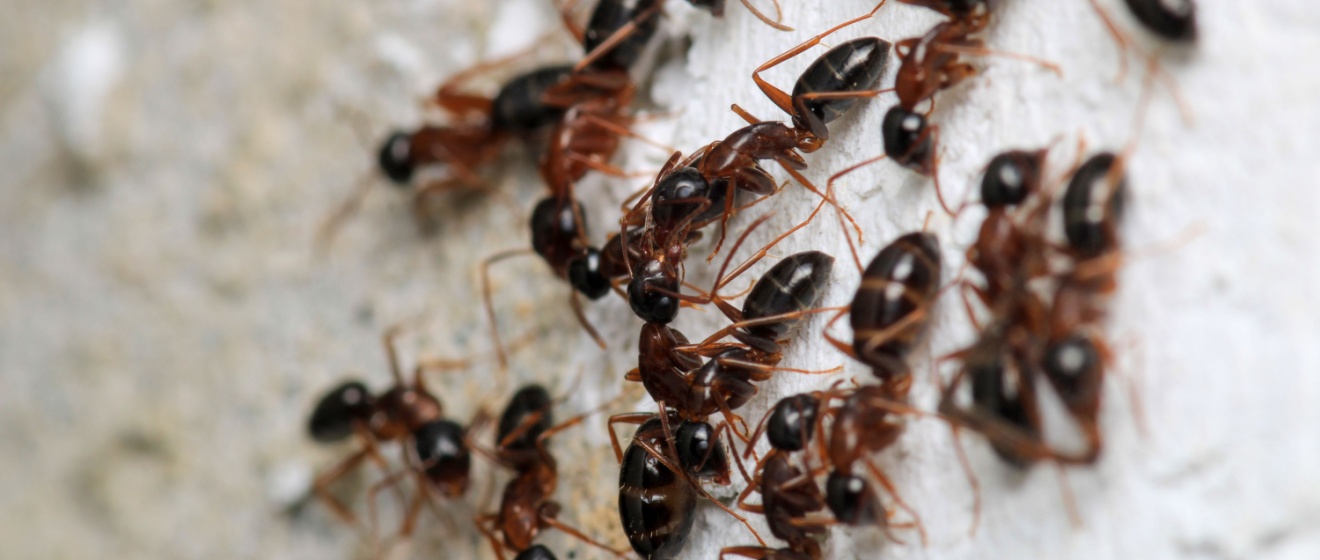
If ants have become a recurring issue in your Lebanon home—trails that reform within hours of cleaning, activity in multiple rooms, or the same problem returning every spring and summer—the colony near your foundation has not been eliminated. The methods most homeowners rely on address the visible trail without reaching the source. Here is a clear process for resolving the problem and preventing it from returning with professional ant control.
Step 1: Identify the Species
The species determines the treatment strategy. Small, dark ants trailing in organized lines along counters and baseboards are most likely odorous house ants or pavement ants—the most common indoor species in Wilson County. Large, dark ants seen individually or at night may be carpenter ants, which excavate galleries inside moisture-damaged wood and cause structural damage. Reddish-brown ants with mounds in the yard are fire ants.
Carpenter ants and fire ants each require specific treatment approaches. If you are unsure which species you are dealing with, a professional inspection will identify it.
Step 2: Clean the Trail and Remove the Attractant
Wipe the active trail with soapy water to break the pheromone signal. Identify what the ants are targeting—food, moisture, or shelter—and eliminate access. Fix dripping faucets. Store food in sealed containers. Clean up grease residue near the stove. Do not spray the trail with a consumer repellent product.
Step 3: Seal the Entry Point
If you can identify where ants are entering—a crack in the baseboard, a gap around a pipe, worn weatherstripping—seal it with caulk or weatherstripping. This closes the immediate pathway but does not address the colony or the other potential entry points in the home.
Step 4: Call for Colony-Level Treatment
Steps 1 through 3 address the symptom. The colony is still intact. Professional treatment with non-repellent products uses the colony’s own social behavior to deliver a lethal dose from foragers to the queen. The product spreads through the population over one to three weeks. The colony collapses from within.
A professional also provides the exterior barrier treatment—Apple’s Environmental treats a 3-zone perimeter up to 9 feet from the foundation—that intercepts foragers before they reach the home. Interior crack-and-crevice treatment at confirmed entry points provides additional protection.
Step 5: Reduce Conducive Conditions
Between professional visits, homeowner habits amplify the results:
- Pull mulch back from the foundation and keep it shallow
- Correct drainage so water flows away from the home
- Trim vegetation so it does not contact the exterior
- Address moisture-damaged wood—this is particularly important for carpenter ant prevention
- Clean gutters to prevent overflow against the foundation and fascia
If your home has elevated moisture conditions in the crawl space or along the foundation, Apple’s Environmental’s moisture control services can address the underlying conditions that attract ants, termites, and other moisture-dependent pests.
Step 6: Stay on the Program
Lebanon’s climate sustains ant colony activity for most of the year. The warm soil, the regular rainfall, and the humidity that defines Middle Tennessee mean that new ant colonies continuously establish near residential foundations. A one-time treatment eliminates the current colony. Quarterly service through the Pest 365 plan maintains the barrier that prevents the next one from reaching the inside of your home.
Apple’s Environmental has been serving Lebanon since the early 1990s. The company is QualityPro certified, uses an IPM approach, and offers plans starting at $50 per month with complimentary retreats and a satisfaction guarantee.
If ants keep coming back in your Lebanon home, contact Apple’s Environmental for a free estimate and get treatment that targets the colony, not just the trail.